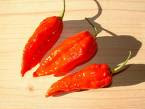
Indian chilli acquires cult following in US
Chidanand Rajghatta, TNN 5 September 2009, 09:41pm IST
WASHINGTON:
Nearly a decade after it was first discovered to be the hottest chilli on earth, the Indian firecracker named Bhut Jolokia, aka Naga Jolokia, has acquired a cult following in the west among so-called chilli-heads.
That’s right; like Dead-heads, who idolize the rock group Grateful Dead, and gear-heads who worship all things mechanical, chilli-heads revere some of the hottest chillis on the planet. And they don’t come hotter than Bhut (or Naga) Jolokia, so-named because it is native to the fiery Naga tribe, and those who taste it are said to turn ghostly.
Measured at more than one million Scofield Heat Units (SHU), Bhut Jolokia is twice as hot as the previous champ -– California’s Red Savina -- who it worsted earlier this decade (Mexican pretenders like Habanero were no match). Since then, the little hottie has become a legend among chilli-heads, grown tenderly in hothouses across the country, discussed animatedly in the higher reaches of the spice world, and sold like gold and other precious commodity on the Internet. Last month, there were 92 Jolokia related items on eBay.
''Bhut Jolokia is a beauty,'' chortled John Hard, whose Ohio-based company CaJohn (after Cajun) sells the Indian chilli in several forms, mostly sauces. ''There are lots of pretenders cranked up with oleoresins, but BJ delivers both flavor and heat in a natural way.''
Hard first heard of the fiery Indian chilli after New Mexico State University’s Chilli-Pepper Institute followed up on the claims of the Indian Ministry of Defence and found that its assertion of having found the hottest chilli in the world was true (It's not hard to guess what the MoD is using it for). Word quickly got around the esoteric (or, es-hot-teric) world of chilli-heads, and before long, it was being grown with feverish passion.
It’s a tough ask in the US, where the weather in most parts of the country is not exactly conducive to growing jolokias. Barbara Blankenship, a radiologist, and her husband Toby Morris, a fire-fighter, have just about managed to coax a few saplings in their greenhouse outside Seattle, a city better known for its cool, damp climate. ''We wanted to grow it after reading about it in a cooking magazine,†says Blankenship, an ardent gardener. ''We got the seed from Seedrack.com down in Oregon and we now have five plants that are doing well.''
Toby has a more involved explanation about why jolokia has become such a hot commodity. ''I think Americans are pretty fascinated with things that are the oldest, biggest, whateverest,†he says, recalling that he grew up with a copy of the Guinness Book of World Records. In the Fire Service, his colleagues were always trying to make the hottest chili (soupy dish); not always the tastiest, just the hottest. “Maybe it is that there aren't too many dragons for a guy to slay anymore and no frontiers to conquer?'' he wonders.
But the Seattle couple’s saplings are yet to bear any glowing results. John ''CaJohn'' Hard, who is also a former fire-fighter, has been quicker off the blocks. Last month, when he spoke to ToI, he had a jolokia plant that bore six chilli pods.
But across US, and in fact, even in Europe (who would have thunk?) chilli-heads are starting to crank them out with increasing success, says CaJohn. Most of the stuff is still imported from India though, from a company in Tezpur.
CaJohn has a whole array of Jolokia products, most of them priced around $ 10 for a bottle. The first of them is called Holy Jolokia, but the rest, driven by the owner’s spicy fervor, has lapsed into blasphemy.
When Hard came up with a Jolokia sauce and named it Nagasaurus, an artist who did the label for the bottle joked that it should be named ''Naga-sore-ass.'' He did, and the sore-ass label now outsells the saurus by 40 to one. Next up, CaJohn came up with ''Kiss my Bhut.''
Its the beginning of Saga Jolokia.
Report in Times Of India 5th sept 2009
Saturday, September 5, 2009


Monday, August 3, 2009
CHILI PEPPER FACE WASH....Bye bye acne

A new product called "Capisderm", made from chili peppers, is said to help eliminate acne. The product, made by SiCap Industries, LLC, a manufacturer of herbal supplements, claims to wipe out acne in a matter of days, without any of the burning sensation people come to expect from chili peppers.
The key ingredient is Capsaicin, naturally found in chili peppers, and known to be a promising acne fighter. According to Capisderm's press release...
Researchers believe it works on two fronts - First the thermal heat action of Capsaicin helps to open pores and increase blood flow to the surface of the skin. Secondly, Capsaicin has powerful antimicrobial properties that help distinguish harmful bacteria that's hiding within the layers of skin. Capsaicin also helps to desensitize sensitive skin by affecting a series of tiny nerves, and in this way it may also be beneficial for relieving chronic topical pain associated with certain circulatory conditions.
The company claims that there are immediate results within the first day or two of use. Most acne conditions will disappear completely within the first week, even with severe cases, and also prevents future outbreaks. The company claims that it will reduce wrinkles.
Eventhough this news is a bit old, it is worth a mention here.
Chili Pepper Face Wash
by Steve
Monday, July 25, 2005
With thanks from "Strange new products" a clear digital media publication
CHILI PEPPER FACE WASH......!!!!

Eventhough This news is a bit old, it is worth a mention here.
Chili Pepper Face Wash
by Steve
Monday, July 25, 2005
A new product called "Capisderm", made from chili peppers, is said to help eliminate acne. The product, made by SiCap Industries, LLC, a manufacturer of herbal supplements, claims to wipe out acne in a matter of days, without any of the burning sensation people come to expect from chili peppers.
The key ingredient is Capsaicin, naturally found in chili peppers, and known to be a promising acne fighter. According to Capisderm's press release...
Researchers believe it works on two fronts - First the thermal heat action of Capsaicin helps to open pores and increase blood flow to the surface of the skin. Secondly, Capsaicin has powerful antimicrobial properties that help distinguish harmful bacteria that's hiding within the layers of skin. Capsaicin also helps to desensitize sensitive skin by affecting a series of tiny nerves, and in this way it may also be beneficial for relieving chronic topical pain associated with certain circulatory conditions.
The company claims that there are immediate results within the first day or two of use. Most acne conditions will disappear completely within the first week, even with severe cases, and also prevents future outbreaks. The company claims that it will reduce wrinkles.
Thursday, July 23, 2009
ATMs ....Equipped now with Pepper spray

Pepper-spray defence means
Thieves face squirt of eye-watering chemical
New security feature to thwart exploding cash machine
raids
David Smith in Johannesburg guardian.co.uk, Sunday 12 July 2009 17.27 BST
Cash machines offer an ever-growing menu of services beyond merely dispensing money. For tampering criminals, this now includes a squirt of pepper spray in the face .
The extreme measure is the latest in South Africa's escalating war against armed robbers who target banks and cash delivery vans. The number of cash machines blown up with explosives has risen from 54 in 2006 to 387 in 2007 and nearly 500 last year.
The technology uses cameras to detect people tampering with the card slots. Another machine then ejects pepper spray to stun the culprit while police response teams race to the scene.
But the mechanism backfired in one incident last week when pepper spray was inadvertently inhaled by three technicians who required treatment from paramedics.
Patrick Wadula, spokesman for the Absa bank, which is piloting the scheme, told the Mail & Guardian Online: "During a routine maintenance check at an Absa ATM in Fish Hoek, the pepper spray device was accidentally activated.
"At the time there were no customers using the ATM. However, the spray spread into the shopping centre where the ATMs are situated."
In conjunction with the police, Absa is using the technology at 11 sites, identified as high-risk by branch managers.
If successful, it will be expanded to cash machines around the country.
With thanks from Guardian
Sunday, July 19, 2009
CHINESE DRIVING ........Trick or Treat?

Police in southwest China are spicing up drivers with raw chili in a bid to stop them from falling asleep at the wheel, a newspaper said.
Police in Chongqing started serving drivers chili peppers at highway service stations, holding to the traditional Chinese belief people often feel more sleepy in the Spring, the Chongqing Evening News said.
Most of the drivers are from neighboring Sichuan, Yunnan and Hunan provinces, where chilies are a local favorite, it added.
"It's really good to have some hot peppers when you are tired from driving," van driver Chen Jun was quoted by the newspaper as saying. "They make you alert."
China's roads have long been among the most dangerous in the world due to overloaded and speeding trucks and drivers who switch lanes without signaling and often ignore traffic lights.With thanks from the net
Friday, July 17, 2009
OFFICIAL "HOLY JOLOKIA SAUCE"
Monday, May 4, 2009
NMSU inks hot deal on world’s spiciest pepperNew Mexico Business Weekly
The Chile Pepper Institute at New Mexico State University has partnered with a private company to create a hot sauce with the world’s hottest chile pepper.
It’s the first time the Institute has joined with a private firm to produce a product. The Holy Jolokia sauce is produced by CaJohns Fiery Foods, based in Columbus, Ohio, and is made from the Bhut Jolokia pepper, which the Institute and the Guinness Book of Records certify is the hottest pepper on the planet.
Paul Bosland, director of the Chile Pepper Institute, said the new product will help further cement New Mexico as the chile capital of the world.
The Bhut Jolokia chiles are grown in India and their reputation has boosted production in that country by more than 25 percent, according to NMSU officials.
The pepper has more than one million Scoville Heat Units, which makes it nearly twice as hot as the Red Savina, the pepper which once held the hottest crown.
New Mexico green chile contains about 1,500 Scoville Heat Units. An average jalapeño has about 10,000.
The 5-ounce bottles of Holy Jolokia retail for $10 and a portion of the sales will help fund research and education at the Chile Pepper Institute. The Institute is the only organization devoted to education, research and archiving information on chile peppers. Plans are in the works to raise $10 million for an endowed chair in the institute and establish a new facility with a tourist venue that will include accommodations for conferences and teaching, and a demonstration garden and greenhouse.
With thanks from net
NMSU inks hot deal on world’s spiciest pepperNew Mexico Business Weekly
The Chile Pepper Institute at New Mexico State University has partnered with a private company to create a hot sauce with the world’s hottest chile pepper.
It’s the first time the Institute has joined with a private firm to produce a product. The Holy Jolokia sauce is produced by CaJohns Fiery Foods, based in Columbus, Ohio, and is made from the Bhut Jolokia pepper, which the Institute and the Guinness Book of Records certify is the hottest pepper on the planet.
Paul Bosland, director of the Chile Pepper Institute, said the new product will help further cement New Mexico as the chile capital of the world.
The Bhut Jolokia chiles are grown in India and their reputation has boosted production in that country by more than 25 percent, according to NMSU officials.
The pepper has more than one million Scoville Heat Units, which makes it nearly twice as hot as the Red Savina, the pepper which once held the hottest crown.
New Mexico green chile contains about 1,500 Scoville Heat Units. An average jalapeño has about 10,000.
The 5-ounce bottles of Holy Jolokia retail for $10 and a portion of the sales will help fund research and education at the Chile Pepper Institute. The Institute is the only organization devoted to education, research and archiving information on chile peppers. Plans are in the works to raise $10 million for an endowed chair in the institute and establish a new facility with a tourist venue that will include accommodations for conferences and teaching, and a demonstration garden and greenhouse.
With thanks from net
Friday, July 3, 2009
New device uses carbon nanotubes to rate chillis hotness
London, May 13 (ANI): Scientists have developed a new device that takes the help of carbon nanotubes to provide an objective and cost effective way to rate how hot a particular chilli is.
According to a report in Nature News, Richard Compton, a chemist at the University of Oxford, UK, and his colleagues have made the device, which measures the accumulated concentrations of the capsaicins in a chilli simultaneously.
Capsaicins are chemicals, which cause the hotness in a chilli. The higher the concentration, the hotter a chilli tastes.
The conventional method to determine the heat of a chilli or chilli sauce was devised in 1912 by chemist Wilbur Scoville.
Scoville ratings are worked out by diluting a chilli-containing sauce to the point at which a team of five expert tasters can no longer detect the heat.
But Richard Compton and his colleagues have developed a way to get a Scoville rating for a sauce while sparing the tasters tongues, and without blowing a cooks budget.
The device that they have developed measures the accumulated concentrations of the capsaicins in a chilli simultaneously.
The technique involves coating electrodes covered in carbon nanotubes with the chilli sample. The nanotubes have a high surface area, which means that they can absorb lots of the sample.
The whole device is then dunked in an ethanol-based solution to oxidize the capsaicins, which causes current to flow.
Stronger chillies mean more electric current, said Compton.
According to Compton, his method is cheaper than the only other available tester-free method, called high-pressure liquid chromatography (HPLC).
The HPLC technique involves separating out the capsaicins in a sauce and working out their concentrations individually an expensive process.
By using mass-producible electrodes screen-printed with carbon nanotubes, Compton reckons he can bring down the cost of a sampler to around 30 pounds. By comparison, an HPLC machine costs around 40,000 pounds.
Compton has applied for a patent for his device and is attracting commercial interest for what he envisages as a cheap, disposable hand-held heat detector that keen cooks could use in their own kitchens. (ANI)
with thanks to Thaindian news
According to a report in Nature News, Richard Compton, a chemist at the University of Oxford, UK, and his colleagues have made the device, which measures the accumulated concentrations of the capsaicins in a chilli simultaneously.
Capsaicins are chemicals, which cause the hotness in a chilli. The higher the concentration, the hotter a chilli tastes.
The conventional method to determine the heat of a chilli or chilli sauce was devised in 1912 by chemist Wilbur Scoville.
Scoville ratings are worked out by diluting a chilli-containing sauce to the point at which a team of five expert tasters can no longer detect the heat.
But Richard Compton and his colleagues have developed a way to get a Scoville rating for a sauce while sparing the tasters tongues, and without blowing a cooks budget.
The device that they have developed measures the accumulated concentrations of the capsaicins in a chilli simultaneously.
The technique involves coating electrodes covered in carbon nanotubes with the chilli sample. The nanotubes have a high surface area, which means that they can absorb lots of the sample.
The whole device is then dunked in an ethanol-based solution to oxidize the capsaicins, which causes current to flow.
Stronger chillies mean more electric current, said Compton.
According to Compton, his method is cheaper than the only other available tester-free method, called high-pressure liquid chromatography (HPLC).
The HPLC technique involves separating out the capsaicins in a sauce and working out their concentrations individually an expensive process.
By using mass-producible electrodes screen-printed with carbon nanotubes, Compton reckons he can bring down the cost of a sampler to around 30 pounds. By comparison, an HPLC machine costs around 40,000 pounds.
Compton has applied for a patent for his device and is attracting commercial interest for what he envisages as a cheap, disposable hand-held heat detector that keen cooks could use in their own kitchens. (ANI)
with thanks to Thaindian news
Subscribe to:
Posts (Atom)